

CINA-VCF AI Detection of Vertebral Compression Fractures on Chest and Abdominal CT
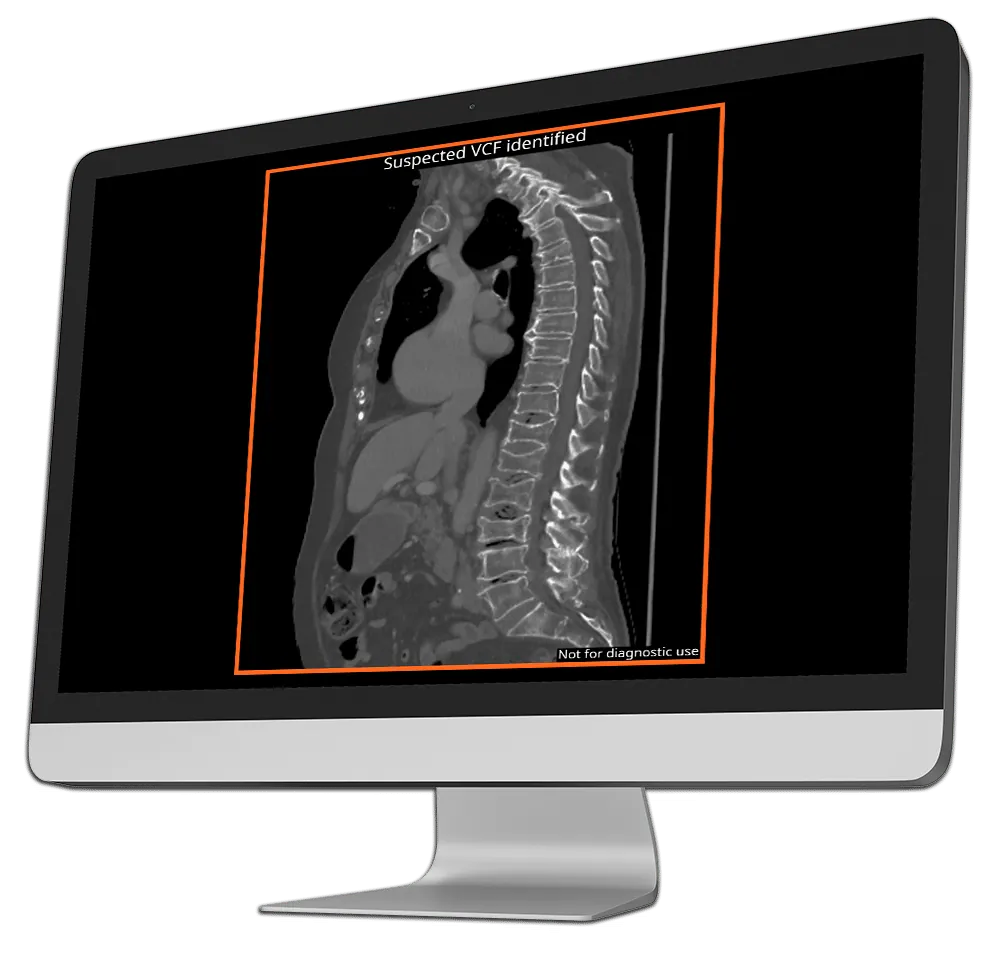
CINA-VCF and CINA-VCF Quantix take a preventive approach to bone health. A vertebral compression fracture (VCF) occurs when a vertebra collapses because the bone has weakened, often with osteoporosis. On chest and abdominal CT ordered for any clinical indication, these fractures are often visible but unreported. Both tools help radiologists report them promptly, so the patient’s fracture risk can be managed early: CINA-VCF for triage and notification (United States), CINA-VCF Quantix for vertebral labeling and vertebral height loss measurement (outside the United States).

The Fracture on a Scan Not Looking for It.
An estimated 1.4 million clinical vertebral fractures occur each year worldwide (Johnell and Kanis, Osteoporosis International, 2006), around 700,000 of them in the United States, and only about one in three comes to clinical attention. The scan was ordered for another indication, and the radiologist’s attention is on that question. The fracture is present, visible in the field of view, and in most cases, not in the report.
Scans ordered for cancer, fractures found by accident
Oncology patients undergo repeated CT scans for staging and surveillance. Metastasis, treatment, and age all contribute to bone fragility. Vertebral compression fractures are common in this population and frequently appear on thoraco-abdominal CT as secondary findings.
Every CT is an opportunity
Older adults undergo chest and abdominal CT for a wide range of indications. Vertebral compression fractures are prevalent in patients 50 and over, and many go undetected until the patient presents with a second fracture, or until pain prompts a dedicated bone workup weeks or months later.
An unreported VCF is not a neutral outcome. Women with severe vertebral fractures carry a 12.6-times greater risk of a new vertebral fracture. A prior vertebral fracture increases hip fracture risk 2.3-fold. Hip fractures carry a 20 to 24% first-year mortality rate.
Vertebral Compression Fracture Detection
Triage and notification tool for adults aged 50 and over undergoing non-enhanced or contrast-enhanced CT of the chest and/or abdomen, flagging suspected moderate and severe vertebral compression fractures.
Source: FDA 510(k) standalone performance study (2024), slice thickness ≤ 3 mm.
Quantification tool for non-enhanced and contrast-enhanced chest and/or abdominal CT: labels T1 to L5 and measures vertebral height loss.
Source: clinical evaluation report under the EU Medical Device Regulation (MDR 2017/745), slice thickness ≤ 3 mm.
Detection Coverage
Backed by peer-reviewed studies
Peer-reviewed studies validating CINA-VCF performance.
474 chest and abdominal CT scans of patients aged 50 and over, in several countries: 95.2% sensitivity, AUC 0.97.
Scientific exhibit presenting CINA-VCF performance on chest and abdominal CT.
1,556 stage IV cancer patients: 83.5% of the AI-flagged fractures confirmed by experts were absent from the original reports.
100 patients on opportunistic CT: 94.9% vertebral labeling agreement with radiologists.
Figures as reported by each study.
Your questions, answered
What is a vertebral compression fracture, and why report it?
A vertebral compression fracture (VCF) occurs when one or more vertebrae collapse or break because the bone has weakened, most often in osteoporosis, where bone density decreases. A first VCF is a warning sign of bone fragility: reporting it promptly gives the care team the chance to start bone health management and reduce the risk of further fractures. CINA-VCF and CINA-VCF Quantix are designed for this preventive approach, flagging fractures on CT scans acquired for other reasons so that they reach the report.
Why are vertebral compression fractures detected but not reported?
The scale of the reporting gap is documented. In one large study, 14.1% of patients aged 60 and over showed radiographic evidence of moderate or severe vertebral fractures on imaging. Of those, only 50% were mentioned in the radiology report. Nearly half of all visible, clinically significant vertebral fractures were present on the scan and absent from the report. The fracture is in the field of view of a chest or abdominal CT ordered for another reason, and the radiologist’s mandate is to answer the clinical question that was asked. CINA-VCF flags every qualifying finding before the case is closed, ensuring the radiologist has the information needed to assess and report it as part of the same acquisition.
What does CINA-VCF detect, and which patients is it designed for?
CINA-VCF is a triage and notification tool that detects unsuspected vertebral compression fractures in adults aged 50 and over undergoing non-enhanced or contrast-enhanced CT that includes the chest and/or abdomen, for any clinical indication. Suspected cases are flagged in the worklist within approximately 23 seconds. It flags suspected moderate and severe vertebral compression fractures from T1 to L5 as incidental findings in scans ordered for other clinical reasons, such as oncology staging, respiratory workup, or routine abdominal investigation. It does not detect mild fractures (Grade 0) or cervical spine fractures. Cases with surgical hardware in the spinal region and vertebrae with cement from prior vertebroplasty or kyphoplasty are automatically excluded.
What is the difference between CINA-VCF and CINA-VCF Quantix?
CINA-VCF is an active triage tool. When it identifies a suspected moderate or severe vertebral compression fracture, it sends an alert to the radiologist’s worklist within approximately 23 seconds so the case can be prioritized. CINA-VCF Quantix is a quantification tool. It processes every qualifying CT, labels all visible T1-L5 vertebrae, measures vertebral height loss for each one, and measures the mean Hounsfield Unit value. It sends a passive notification when any vertebra exceeds the configured threshold. Both tools run on the same CT scan and can be deployed on the same infrastructure. CINA-VCF is FDA-cleared (United States only). CINA-VCF Quantix is CE-marked and available outside the United States only.
- Instructions for Use for both tools are available.
- Manufacturer: Avicenna.AI (France).
- CINA-VCF: Medical device Class II following the Code of Federal Regulations of the United States of America 21CFR on Medical Devices.
- CINA-VCF Quantix: Medical device Class IIb following the European Regulation on Medical Device (EU) 2017/745.
Complete your Spine AI portfolio.
See it in a real clinical case
Complete the form below to access the CINA-VCF Quantix case study.