
CINA-LVO AI-Powered Large Vessel Occlusion Detection on CT
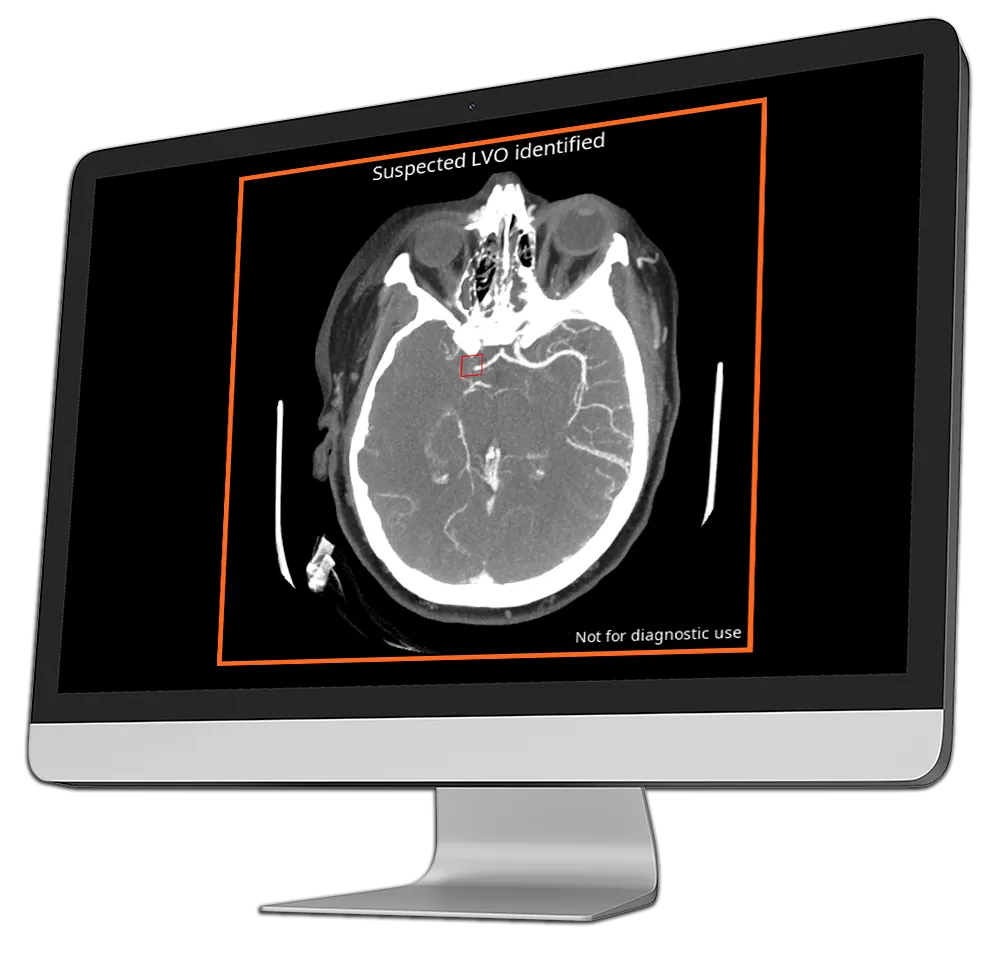
Large vessel occlusion is responsible for the most severe ischemic strokes. CINA-LVO analyzes brain CT angiography scans automatically and delivers results to your radiologist's worklist within a few seconds.
Anterior Circulation Coverage
Large vessel occlusion is not a single presentation. It spans a spectrum of vessel segments, each carrying a different level of clinical visibility, and a different risk of being missed.
ICA terminus and MCA M1
ICA terminus and MCA M1 occlusions are the most severe presentations of ischemic stroke. When a radiologist identifies one, it triggers an immediate cascade: stroke team activation, angiography suite preparation, thrombectomy team on standby. CINA-LVO provides a first-pass analysis before the radiologist opens the scan, so confirmation, not detection, becomes the task.
Proximal MCA M2
Proximal MCA M2 occlusions are smaller, subtler, and significantly harder to see on CTA. Vessel tortuosity, contrast timing variability, and reading fatigue all raise the risk of a missed finding. CINA-LVO covers the proximal M2 segment, validated in a dedicated peer-reviewed study.
Every CT angiography scan is analyzed automatically, from ICA to proximal M2, regardless of the time of day, the scan volume, or the complexity of the presentation. The radiologist receives an alert before reviewing the case.
Large Vessel Occlusion Detection
Triage tool for CT angiography detecting large vessel occlusions across the anterior circulation in acute ischemic stroke.
Source: FDA 510(k) standalone performance study (2020), slice thickness ≤ 1.25 mm.
Triage tool for CT angiography detecting large vessel occlusions across the anterior circulation in acute ischemic stroke.
Source: clinical evaluation report under the EU Medical Device Regulation (MDR 2017/745), slice thickness ≤ 1.25 mm.
Detection Coverage
Backed by peer-reviewed studies
Peer-reviewed studies validating CINA-LVO performance.
Validation on 378 CT angiography scans in a US multicenter setting, across a diverse acute stroke population.
In a real-world emergency stroke workflow, average radiologist reading time was 6.5x faster, without loss of accuracy.
Study of 557 patients including MCA M2 occlusions, the vessel segment most often missed on standard CTA review.
Figures as reported by each study.
A Radiologist’s Perspective
“When dealing with a stroke, time is of the essence, and being able to prioritize effectively is critical to saving lives and improving outcomes. Not only does CINA help radiologists to identify pathologies quickly, but also to highlight those that require the most urgent care.”

Your questions, answered
Which vessel segments does CINA-LVO detect?
CINA-LVO detects large vessel occlusions across the anterior circulation: distal Internal Carotid Artery, the middle cerebral artery M1 segment, and the proximal MCA M2 segment.
How does CINA-LVO handle CTA scans with suboptimal contrast timing or acquisition variability?
CINA-LVO has been validated across multicentre, multivendor cohorts, including scans acquired under varying contrast timing conditions and kilovoltage settings. An automatic protocol check verifies that each series meets the acquisition criteria, including contrast quality, and series that do not may be rejected.
How does CINA-LVO fit into the stroke workflow without adding steps for the radiologist?
CINA-LVO connects to your PACS via standard DICOM. When a brain CTA is acquired, the analysis runs automatically, with no manual trigger and no separate application. The result appears directly in the radiologist’s worklist as an additional overlay image, with a flag if an occlusion is detected. The radiologist confirms or rules out the finding before any clinical decision is made. No extra login, no workflow change.
- Instructions for Use are available.
- Manufacturer: Avicenna.AI (France).
- Medical device Class IIb following the European Regulation on Medical Device (EU) 2017/745.
- Medical device Class II following the Code of Federal Regulations of the United States of America 21CFR on Medical Devices.
Complete your Neurovascular AI portfolio.
See it in a real clinical case
Complete the form below to access the CINA-LVO case study.