

CINA-CSpine AI Triage for Acute Cervical Spine Fractures on Non-Contrast CT
A trauma patient comes in. A CT is acquired. What happens next determines whether a fracture is caught in the acute window or missed until it causes harm. CINA-CSpine analyzes every qualifying CT automatically, flags suspected fractures before the radiologist opens the case, and delivers a preview with the suspected fracture identified.
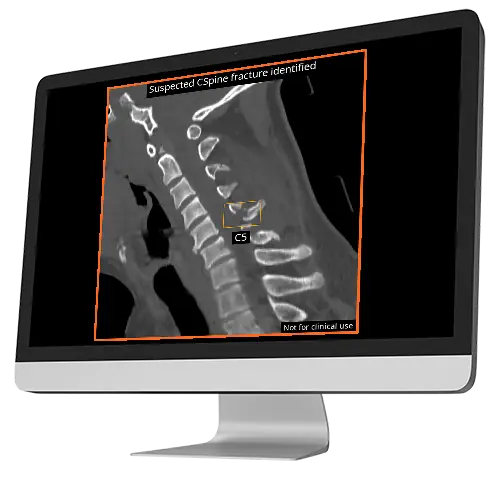
The Fracture That Cannot Wait,
and the One That Cannot Be Seen.
Cervical spine fractures in trauma present in different ways. Some are obvious. Some are not. Both carry consequences when detection is delayed. Earlier surgical decompression is associated with better neurological recovery; delayed decompression is linked to significantly worse outcomes.
Displaced fractures
A displaced cervical fracture fragment is surgically urgent. Spinal cord compression, instability, and neurological deterioration are immediate risks. The clinical question is already open the moment the scan is acquired. A case that waits behind routine studies while the neurosurgical team waits for a result is a case that is losing time.
Non-displaced fractures
Non-displaced fracture lines are radiologically subtle. They require careful attention and often specific windowing to identify. In a high-volume trauma setting, a non-displaced fracture on a cervical CT that is read quickly under pressure can be missed, particularly by trainees reading after office hours.
Every qualifying cervical CT is analyzed automatically, with no manual trigger. Suspected fracture cases are flagged in the worklist before interpretation begins.
Cervical Spine Fracture Detection
Triage and notification tool for non-contrast-enhanced cervical spine CT in adults with suspected acute cervical fracture. Designed to flag acute cervical spine fracture including non-displaced fracture lines and displaced fracture fragments.
Source: FDA 510(k) standalone performance study (2024), slice thickness ≤ 1.25 mm.
Triage and notification tool for non-contrast-enhanced cervical spine CT in adults with suspected acute cervical fracture. Designed to flag acute cervical spine fracture including non-displaced fracture lines and displaced fracture fragments.
Source: clinical evaluation report under the EU Medical Device Regulation (MDR 2024, version 1.0.1), slice thickness ≤ 1.25 mm.
Detection Coverage
Backed by peer-reviewed studies
Peer-reviewed studies validating CINA-CSpine performance.
Real-world validation on 1,055 non-contrast CT scans from a US teleradiology network (7.2% prevalence), ground truth by a board-certified MSK radiologist.
Multicenter, multinational, multivendor study of 328 cervical CT cases, with ground truth from four radiologists.
Figures as reported by each study.
Your questions, answered
What does CINA-CSpine detect, and what scan type does it require?
CINA-CSpine is a triage and notification tool for non-contrast-enhanced CT of the cervical spine in adults with suspected acute cervical fracture. It flags suspected non-displaced fracture lines and displaced fracture fragments. It requires a non-contrast CT with a bone or sharp reconstruction kernel and at least five consecutive visible cervical vertebrae in the field of view. It is not designed to detect vertebral compression fractures.
How does CINA-CSpine fit into the emergency radiology workflow?
CINA-CSpine integrates via standard DICOM into the existing PACS and worklist. Every qualifying cervical CT is analyzed automatically, with no manual trigger required. Suspected fracture cases are flagged in the worklist before interpretation begins. The radiologist reviews the full case and makes the final decision.
Are all CINA-CSpine features available in every market?
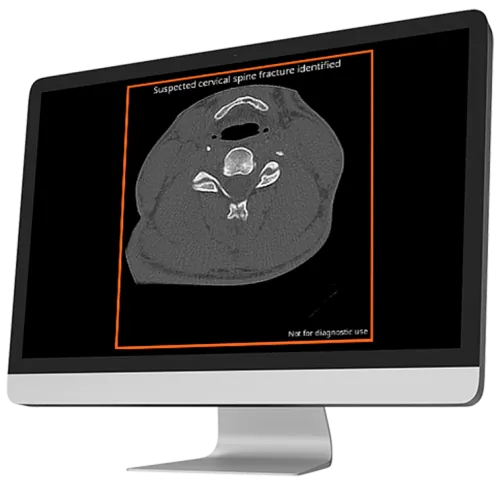
No. Multi-plane previews (axial, coronal and sagittal) and vertebra labeling are available outside the United States only. In the United States, the notification includes a single axial slice.
- Instructions for Use are available.
- Manufacturer: Avicenna.AI (France).
- Medical device Class IIb following the European Regulation on Medical Device (EU) 2017/745.
- Medical device Class II following the Code of Federal Regulations of the United States of America 21CFR on Medical Devices.
Complete your Spine AI portfolio.
See it in a real clinical case
Complete the form below to access the CINA Trauma case study.