

CINA-ASPECTS Automated ASPECTS Scoring on Non-Contrast CT
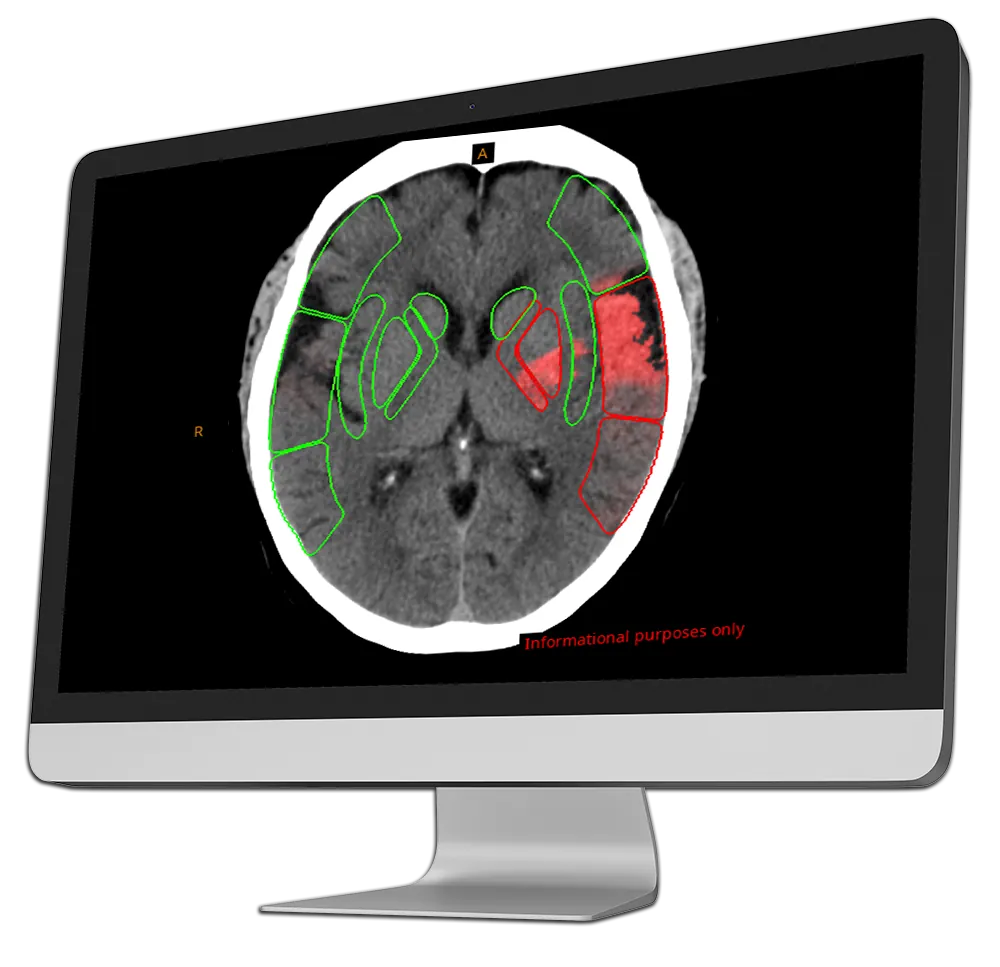
In acute ischemic stroke, confirming a vessel occlusion is only the first step. ASPECTS scoring follows, and the result helps determine whether the patient is eligible for thrombectomy or IV thrombolysis. Indicated for patients with known unilateral ICA or MCA occlusion, CINA-ASPECTS automates that scoring, delivering a standardized result and a region-by-region heat map.
Two Decisions. One Score That Cannot Vary.
The Alberta stroke program early CT score (ASPECTS) is referenced in two critical treatment decisions in acute ischemic stroke. Both are time-sensitive. Both depend on a score that, without AI, is subject to significant reader-to-reader disagreement.
Thrombectomy eligibility
Guidelines recommend mechanical thrombectomy for patients with ASPECTS of 6 or above (AHA/ASA guidelines, Powers et al., Stroke, 2019). A one-point difference can change the decision, and under time pressure that boundary should not depend on who reads the scan. CINA-ASPECTS delivers a standardized, automated score.
Thrombolysis decision
IV thrombolysis decisions also reference ASPECTS, particularly for early ischemic change assessment. In high-volume emergency settings, with multiple scans to read and a stroke team waiting, cognitive fatigue affects scoring accuracy. CINA-ASPECTS automatically delivers a reproducible result regardless of workload, time of day, or reader experience.
A numerical ASPECTS score and a visual heat map highlighting the probability of hypodensity and sulcal effacement by region, supporting faster, more consistent assessment across treatment pathways.
ASPECTS Score Calculation
Automated scoring tool for non-contrast head CT in patients with known ICA or MCA occlusion, quantifying early ischemic changes to support thrombectomy and thrombolysis eligibility decisions in acute ischemic stroke.
Source: FDA 510(k) standalone performance study (2024), 27 scanner models.
Automated scoring tool for non-contrast head CT in patients with known ICA or MCA occlusion, quantifying early ischemic changes to support thrombectomy and thrombolysis eligibility decisions in acute ischemic stroke.
Source: clinical evaluation under the EU Medical Device Regulation (MDR 2017/745), 26 scanners from 4 manufacturers (GE Healthcare, Philips Healthcare, Siemens Healthineers, Toshiba).
Detection Coverage
Backed by peer-reviewed studies
Peer-reviewed studies validating CINA-ASPECTS performance.
AI-assisted ASPECTS scoring improved reader accuracy and reduced reading time across experience levels.
Multinational study of 327 patients: 72.8% sensitivity and 91.8% specificity across sites and scanner vendors.
Multicenter study across ICH, LVO and ASPECTS: high specificity and consistent accuracy across stroke subtypes.
Figures as reported by each study.
A Radiologist’s Perspective
“It’s great to automate the ASPECT Score, because it’s not an easy task. CINA-ASPECTS is a real breakthrough. It’s very useful for radiologists.”

Your questions, answered
What is ASPECTS and why does it matter?
The Alberta Stroke Program Early CT Score (ASPECTS) is a 10-point scale that quantifies early ischemic changes across 10 defined regions of the MCA territory on non-contrast CT. A score of 10 indicates no visible ischemic changes; a score of 0 indicates involvement of all 10 regions. Current stroke guidelines (AHA/ASA guidelines, Powers et al., Stroke, 2019) recommend mechanical thrombectomy for patients with an ASPECTS of 6 or above; a lower score reflects more extensive early infarction. A one-point difference can be decisive in determining a patient’s treatment eligibility.
How does CINA-ASPECTS reduce inter-reader variability?
ASPECTS scoring on non-contrast CT is inherently subjective. Early ischemic changes, subtle hypodensity and sulcal effacement, are difficult to detect consistently, and published data shows significant disagreement between readers, particularly between less experienced and senior radiologists. CINA-ASPECTS applies the same algorithm to every scan, producing a standardized score and a region-by-region heat map that is independent of reader fatigue, experience level, or time of day.
What does CINA-ASPECTS deliver beyond the numerical score?
In addition to the ASPECTS score, CINA-ASPECTS provides three visual outputs: a heat map showing the probability of hypodensity or sulcal effacement across each of the 10 MCA territory regions; an outline of the areas identified as infarcted; and a reoriented and resliced NCCT that makes the comparison between left and right hemispheres easier. These outputs give the radiologist spatial context for the score, supporting faster and more confident reporting in a time-critical stroke workflow.
- Instructions for Use are available.
- Manufacturer: Avicenna.AI (France).
- Medical device Class IIb following the European Regulation on Medical Device (EU) 2017/745.
- Medical device Class II following the Code of Federal Regulations of the United States of America 21CFR on Medical Devices.