
CINA-Cspine

AI Triage for Acute
Cervical Spine Fractures
on Non-Contrast CT

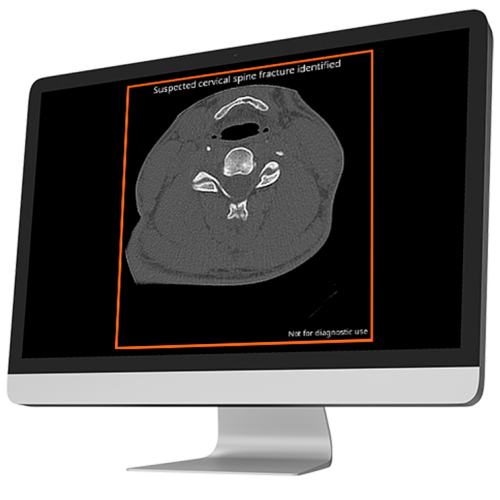
A trauma patient comes in. The cervical spine CT is acquired. What happens next determines whether a fracture is caught in the acute window or missed until it causes harm. CINA-CSpine analyzes every qualifying cervical CT automatically, flags suspected fractures before the radiologist opens the case, and delivers preview images in three planes, axial, coronal, and sagittal, with each suspected fracture site identified and labeled by vertebra.

CE-marked

MDR Class IIb

FDA-cleared

Class II

The Fracture That Cannot Wait, and the One That Cannot Be Seen.

Cervical spine fractures in trauma present in different ways. Some are obvious. Some are not. Both carry consequences when detection is delayed. Patients who receive surgical decompression within 6 hours of injury show a 70% improvement rate. Delay beyond 6 hours, and that figure falls to 12%.

Displaced Fractures

A displaced cervical fracture fragment is surgically urgent. Spinal cord compression, instability, and neurological deterioration are immediate risks. The clinical question is already open the moment the scan is acquired. A case that waits behind routine studies while the neurosurgical team waits for a result is a case that is losing time.

Non-Displaced Fractures

Non-displaced fracture lines are radiologically subtle. They require careful attention and often specific windowing to identify. In a high-volume trauma setting, a non-displaced fracture on a cervical CT that is read quickly under pressure can be missed. In one analysis, 3.1% of cervical spine fractures were missed by trainees reading after office hours.

Every cervical CT with at least five consecutive visible cervical vertebrae is analyzed automatically. Positive cases are flagged in the worklist with up to five preview slices per plane, a bounding box on each suspected fracture site, and a vertebral label (C1 through C7). No manual trigger. No change to the existing workflow.

Cervical Spine Fracture Detection

ct scan showing suspected cspine fracture

Triage and notification tool for non-contrast-enhanced cervical spine CT in adults with suspected acute cervical fracture. Designed to flag non-displaced fracture lines and displaced fracture fragments.

Sensitivity
0 %
Specificity
0 %
AUC
0

Detection Coverage

C1 through C7 Non-displaced fracture lines Displaced fracture fragments

Clinical Evidence

Peer-reviewed studies validating CINA-CSpine performance.

2025

Cotena et al.

ECR 2025

In a large-scale real-world validation, 1,055 anonymized non-contrast CT scans were analyzed from a US teleradiology network, representing typical trauma practice with a 7.2% case prevalence, comparable to real clinical settings. The study covered eight CT manufacturers and 48 scanner models. Ground truth was established by a board-certified musculoskeletal radiologist.

sensitivity across 8 manufacturers, 48 scanner models
0 %

2026

Sung et al.

Diagnostics

In a peer-reviewed multicenter, multinational, multivendor study across a US teleradiology network, a French teleradiology company, and UC Irvine Medical Center, CINA-CSpine was evaluated on 328 non-contrast cervical CT cases. Four radiologists independently established ground truth for case-level diagnosis, fracture localization, and vertebral level labeling across 5 scanner manufacturers.

agreement in vertebral level labeling (C1 through C7)
0 %

Frequently Asked Questions

CINA-CSpine is a triage and notification tool for non-contrast-enhanced CT of the cervical spine in adults with suspected acute cervical fracture. It flags suspected non-displaced fracture lines and displaced fracture fragments, delivers preview images in three planes with vertebral labeling, and notifies the radiologist within few minutes. It requires a non-contrast CT with a bone or sharp reconstruction kernel and at least five consecutive visible cervical vertebrae in the field of view. It is not designed to detect vertebral compression fractures.

When a suspected fracture is identified, CINA-CSpine delivers up to five preview slices per plane, coronal, axial, and sagittal, each framed with an orange contour and a bounding box on the fracture site. Each finding is labeled by vertebra, with a unique color per fracture when multiple levels are involved. For example, a finding at C5 and C7 would receive separate labeled bounding boxes in each plane. If no fracture is detected, a single preview framed in blue is returned.

CINA-CSpine integrates via standard DICOM into the existing PACS and worklist. Every qualifying cervical CT is analyzed automatically, with no manual trigger required. Suspected fracture cases are flagged in the worklist before interpretation begins. The radiologist reviews the full case and makes the final diagnostic decision.

Cervical spine fractures range from stable to immediately life-threatening. Unstable fractures with spinal cord involvement carry the risk of permanent neurological deficit if not identified and stabilized rapidly. The surgical window is narrow: patients who receive decompression within 6 hours of injury show a 70% improvement rate; those who wait beyond 6 hours show only 12%. A fracture that sits unread in a standard worklist is time the surgical team is not preparing. CINA-CSpine flags suspected fractures before interpretation begins, giving the clinical team the maximum possible response window.

CINA-CSpine, medical images analysis software, a medical device manufactured by Avicenna.AI. This medical device is reserved for health professionals. The performance and outputs of this tool may differ slightly according to the software version and applicable regulations.

This software has been designed and manufactured according to the EN ISO 13485 Quality management system. Read the instructions in the notice carefully before any use.

Instructions for Use are available.

Manufacturer: Avicenna.AI (France).

Medical device Class IIb following the European Regulation on Medical Device (EU) 2017/745.

Medical device Class II following the Code of Federal Regulations of the United States of America 21CFR on Medical Devices.

Related AI Solutions

Complete your AI portfolio.

CINA-ICH

Intracranial Hemorrhage detection

AI-powered detection of intracranial hemorrhage on non-contrast CT, covering all hemorrhage types across stroke and trauma pathways.

CINA-VCF

Vertebral Compression Fracture

AI-powered detection of vertebral compression fractures on contrast or non-contrast CT scans of the chest and abdomen, covering T1 through L5