
CINA-ICH

AI-Powered Intracranial Hemorrhage Detection on CT​

Whether caused by stroke or trauma, intracranial hemorrhage is a life-threatening emergency. CINA-ICH analyzes non-contrast CT brain scans in real time and delivers results to your radiologist's worklist within seconds, for every patient, every pathway.

CE-marked

MDR Class IIb

FDA-cleared

Class II

Two Critical Pathways. One Comprehensive Solution.

Intracranial hemorrhage (ICH) can occur in two very different clinical contexts and both demand the same speed of response.

Stroke Pathway

Spontaneous ICH such as intraparenchymal hemorrhage or subarachnoid hemorrhage requires immediate triage to guide treatment decisions and prevent neurological deterioration.

Trauma Pathway

A patient who has sustained a head injury may present with subdural or epidural hematoma, which can be subtle on initial imaging and rapidly life-threatening if missed.

CINA-ICH Covers Both

It provides a systematic, automated review of every non-contrast CT brain scan, helping radiologists prioritize critical findings immediately, regardless of the clinical pathway, the time of day, or the workload.

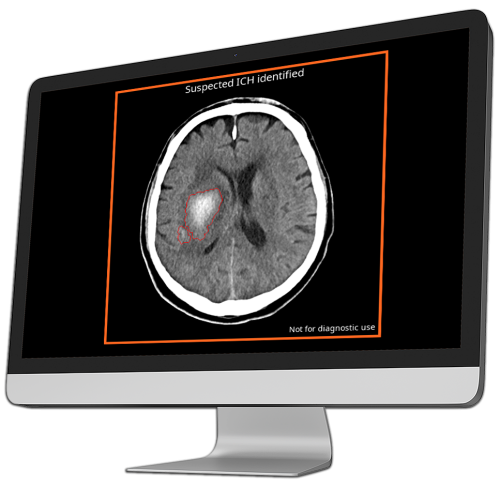
Intracranial Hemorrhage Detection

ct scan showing suspected intracranial hemorrhage

Triage tool for non-enhanced head CT scans detecting bleeding from hemorrhagic strokes and traumatic brain injury.

Sensitivity
0 %
Specificity
0 %
Accuracy
0 %

Detection Coverage

Dedicated CTPA Bilateral pulmonary arteries Main Lobar Segmental

Clinical Evidence

Peer-reviewed studies validating CINA-ICH performance.

2021

McLouth et Al.

Frontiers in Neurology

Demonstrated high sensitivity (91.4%) and specificity (97.5%) across all hemorrhage types in multi-center validation study.

Accuracy
0 %

2024

Ayobi et al.

European Radiology

Significant reduction in radiologist turnaround time with maintained diagnostic accuracy in emergency department setting.

RTAT Reduction
0 %

2021

Agripnidis et al.​

Frontiers in Neurology

High negative predictive value supports safe triage and prioritization in high-volume trauma centers.

NPV
0 %

A Radiologist's Perspective

“Regardless of its location, I think it is extremely important to have a software that helps us detect intracranial hemorrhage. It’s not an easy task. Sometimes the analysis of the radiologist, depending on the time of the day and his expertise, can be mistaken. In my opinion, it’s a useful tool for intraparenchymal hemorrhage detection and for subarachnoid hemorrhage when there is a local hemorrhage under a sulcus or a small bleeding around the circle of Willis.”

smiling man in a blue jacket

Vincent Dousset

Head of Neuro-imaging, CHU Bordeaux (France)

Frequently Asked Question

The algorithm is optimized for acute presentations. Its high specificity for recent bleeds significantly reduces false positives from chronic or incidental findings, so radiologists see alerts that are clinically relevant, not noise from old lesions.

CINA-ICH detects and localizes the full spectrum of acute intracranial hemorrhage on non-contrast CT, covering both spontaneous and traumatic presentations: intraparenchymal hemorrhage (IPH), subarachnoid hemorrhage (SAH), intraventricular hemorrhage (IVH), subdural hematoma (SDH), and epidural hematoma (EDH). Every scan is analyzed automatically, across both stroke and trauma pathways.

CINA-ICH connects to your PACS via standard DICOM, with no changes to scanner hardware or clinical protocols. It is vendor-neutral and available as cloud or on-premise deployment.

CINA-ICH, medical images analysis software, a medical devices manufactured by Avicenna.AI. These medical devices are reserved for health professionals. The performance and outputs of these tools may differ slightly according to the software version and applicable regulations.

These software have been designed and manufactured according to the EN ISO 13485 Quality management system. Read the instructions in the notice carefully before any use.

  • Instructions for Use are available.
  • Manufacturer: Avicenna.AI (France).
  • Medical devices Class IIb following the European Regulation on Medical Device (EU) 2017/745.
  • Medical devices Class II following the Code of Federal Regulations of the United States of America 21CFR on Medical Devices.

Download our Case study

Complete the form below to download our Case Study.

Related AI Solutions

Complete your Head and Spine AI portfolio.

CINA-LVO

Large Vessel Occlusion Detection

CINA-ASPECTS

ASPECT Score Calculation

CINA-CSpine

Cervical Spine Fracture Detection