
CINA-PE

AI-Powered Pulmonary Embolism Detection on Chest CT Angiography

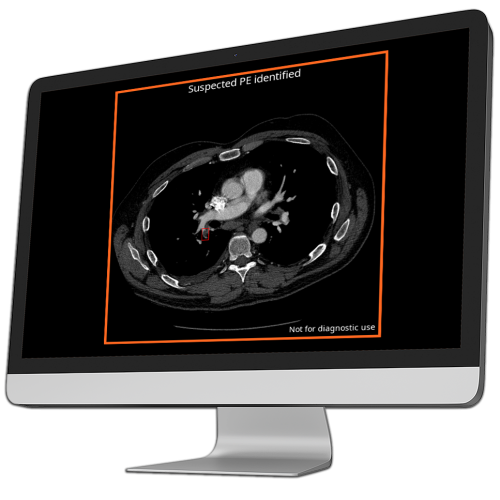
The patient arrived to the ER with acute chest pain and shortness of breath. A dedicated CT pulmonary angiogram (CTPA) has been acquired. the clinical question is open, and the PERT team is standing by. In a standard worklist, The scan waits. CINA-PE moves it to the front, delivering a notification to the radiologist within two minutes of acquisition.

CE-marked

MDR Class IIb

FDA-cleared

Class II

The Worklist Does Not Know the Urgency

A dedicated CTPA for suspected PE is not a routine scan. It is the answer to a clinical question that is already open. The worklist does not sort by urgency.

Massive Pulmonary embolism

When the patient is hemodynamically unstable, the scan result determines whether the PERT team prepares or waits. A suspected PE sitting undifferentiated in a queue is time the clinical team is not acting. CINA-PE flags the case and delivers a notification before it would normally be opened.

STABLE PULMONARY EMBOLISM

Hemodynamically stable does not mean low risk. Clot extension, right heart strain, and deterioration are real consequences of a result that arrives late. With CINA-PE, every suspected positive is flagged immediately, at any hour and at any volume.

Every dedicated chest CT angiography is analyzed automatically. When PE is suspected, the radiologist receives an alert with preview slices showing the suspected location, before the clinical team is kept waiting. No manual trigger. No change to the existing workflow.

Pulmonary Embolism Detection

ct scan showing suspected pulmonary embolism

Triage and notification tool for dedicated chest CT angiography in symptomatic adults with suspected pulmonary embolism, supporting radiologist workflow prioritization in emergency and hospital settings.

Sensitivity
0 %
Specificity
0 %
AUC
0

Detection Coverage

Right main artery Interlobar artery Lobar artery Lobar vein Segmental artery

Clinical Evidence

Peer-reviewed studies validating CINA-PE performance.

2024

Shapiro et al.

Methodist Debakey Cardiovascular Journal

What happens to time-to-consult and in-hospital mortality when suspected PE cases no longer wait in a standard worklist queue? A four-hospital US health system measured the before-and-after following CINA-PE implementation.

Reduction in time to report
- 0 %

2023

Shapiro et al.

Journal of Vascular Surgery

At a high-volume tertiary referral center, researchers tracked whether earlier radiologist notification translated into faster anticoagulation and PERT team mobilization – two decisions that cannot be delayed in acute PE.

Reduction in time-to-report
0 %

2024

Vallée et al.

European Journal of Radiology

Radiology residents are often the first interpreters of after-hours CTPAs, before a senior radiologist reviews the following morning. At Hôpital Foch (France), a reader study evaluated how CINA-PE changes diagnostic performance and inter-reader agreement in that specific scenario.

Sensitivity incl. M2
0 %

A Customer's Perspective

In addition of being a high-performance software, Avicenna.AI gives access to patient results within 2 to 5 minutes, thus allowing radiologists to accelerate time of interpretation, providing a better service for our hospitals and better patient outcomes.

serious man in formal attire

Paul Cayot

Sales Director, Telediag Teleradiology Network (France)

Frequently Asked Questions

CINA-PE is a triage and notification tool for dedicated chest CT angiography in symptomatic adults with suspected pulmonary embolism. It analyzes every CTPA automatically, delivers a notification to the radiologist’s worklist if a suspected PE is identified, and provides a preview of up to five flagged slices. It is not designed for contrast-enhanced CT scans acquired for other clinical reasons.

In a standard worklist, a suspected PE case waits behind routine studies while the clinical team waits for a result. CINA-PE delivers a notification within two minutes of scan acquisition, before the case would normally be reached. In the Shapiro et al. study at a four-hospital US health system, time-to-consult dropped from 240 minutes to under 7 minutes following implementation.

CINA-PE analyzes dedicated CT pulmonary angiography in symptomatic patients referred specifically for suspected PE, using a high-contrast pulmonary timing protocol. CINA-iPE analyzes contrast-enhanced CT scans acquired for entirely different reasons, such as oncology staging or trauma, where PE was not suspected. They are different products, different algorithms, and different clinical workflows.

CINA-PE, medical images analysis software, a medical device manufactured by Avicenna.AI. This medical device is reserved for health professionals. The performance and outputs of this tool may differ slightly according to the software version and applicable regulations.

This software has been designed and manufactured according to the EN ISO 13485 Quality management system. Read the instructions in the notice carefully before any use.

Instructions for Use are available.

Manufacturer: Avicenna.AI (France).

Medical device Class IIb following the European Regulation on Medical Device (EU) 2017/745.

Medical device Class II following the Code of Federal Regulations of the United States of America 21CFR on Medical Devices.

Download our Case study

Complete the form below to download our Case Study.

Related AI Solutions

Complete your AI portfolio.

CINA-iPE

Opportunistic PE detection

CINA-AD

Aortic Dissection Detection