
CINA-iPE

AI Detection of Incidental Pulmonary Embolism on Contrast-Enhanced CT

A Thoracic-Abdominal-Pelvic (TAP) scan is ordered for oncology staging, trauma, or another clinical indication that includes the lung region. Pulmonary embolism was not suspected. Symptoms are absent, or masked by the primary condition. CINA-iPE analyzes every qualifying scan automatically and flags incidental clots, enabling early treatment and preventing the patient from going home with an undetected PE, only to return later as an emergency.

CE-marked

MDR Class IIb

FDA-cleared

Class II

The Finding Nobody Was Looking For.

These patients are already dealing with something serious. The scan was ordered for that. PE was not on the differential, and in many cases nothing points to it.

Oncology Patients

Incidental PE is found in approximately 3.6% of oncologic CT scans. The scan is acquired for staging, not for the pulmonary arteries, and contrast opacification in those vessels is low. Cancer patients face elevated PE risk from both malignancy and treatment, and any symptoms are easily attributed to the primary diagnosis. PE is not the question of the day. CINA-iPE flags it automatically.

Post-Surgical & Trauma

Post-surgical and trauma patients are already symptomatic for other reasons. Signs that might raise PE suspicion in another context go unremarked here. A secondary finding on a scan focused on something else can be missed entirely, or reported late enough that the clinical window has closed.

Patient Leakage: A Missed PE Is a Future Emergency

Without detection at the time of the scan, the patient is discharged. The PE progresses. They return hours, weeks, or months later, sometimes as an emergency. In the IGR oncology study, 13.5% of patients with a missed or delayed PE diagnosis were discharged and readmitted. This not only worsens their clinical outcome but adds significant time and cost burdens for both the patient and the hospital. CINA-iPE flags the finding before the patient leaves.

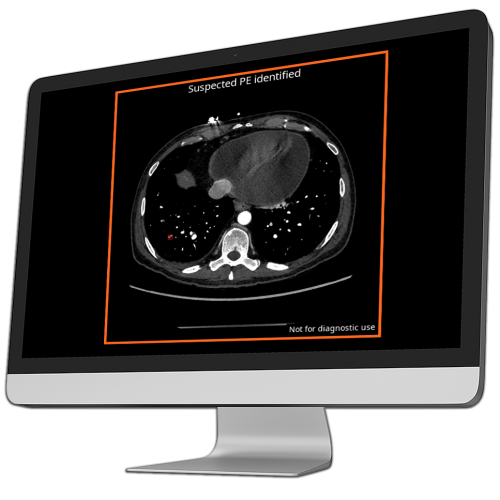
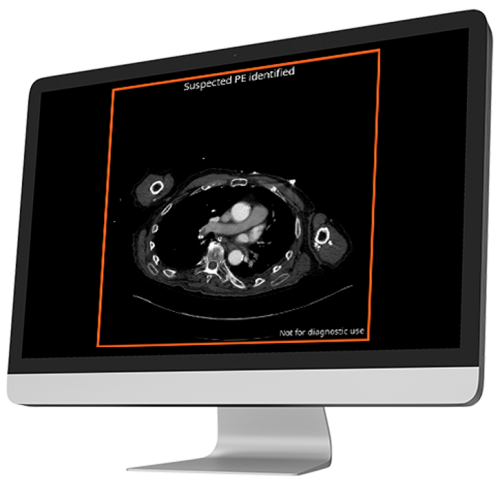
Opportunistic Pulmonary Embolism Detection

ct scan showing suspected pulmonary embolism

Triage and notification tool for contrast-enhanced CT scans acquired with portal timing (non-CTPA protocol), where contrast opacification of the pulmonary arteries is below 200 HU.

Sensitivity
0 %
Specificity
0 %
AUC
0

Detection Coverage

Full body scan Thoraco-abdominal-pelvic scan Abdominal-pelvic scan Chest scan

Clinical Evidence

Peer-reviewed studies validating CINA-PE performance.
of missed PE cases detected
0 %
discharged and readmitted
0 %
received same-day anticoagulation
0 %

2024

Ammari et al.

Life

Oncology CT scans are ordered for one reason. PE is not it. At Institut Gustave Roussy (France), researchers studied 3,047 surveillance scans to measure how often incidental PE was missed without AI, and what changed with CINA-iPE.

A Customer's Perspective

REAL-WORLD DEPLOYMENT

AI alerts generated
0
Confirmed by radiologists
0
Incidental findings caught
0

We are very pleased with the integration of CINA-iPE into our teleradiology workflow. This demonstrates the concrete value of artificial intelligence as a complementary tool to human expertise, including unexpected incidental findings that would otherwise have been missed.”

blue logo with letters tim

Cédric Munschy

Commercial Director, TIM Téléimagerie (France)

Frequently Asked Questions

Incidental pulmonary embolism is PE discovered on a contrast-enhanced CT ordered for a different clinical reason, such as oncology staging, trauma, or post-surgical follow-up. The patient was not referred for a PE workup, and PE is not what the radiologist is looking for. It affects approximately 3.6% of oncologic CT scans. Untreated, it carries a risk of recurrence, hemodynamic deterioration, and emergency readmission. Identified at the time of the scan, it can be managed before the patient is discharged.

CINA-PE analyzes dedicated CT pulmonary angiography in symptomatic patients referred specifically for suspected PE, using a high-contrast pulmonary timing protocol. CINA-iPE analyzes contrast-enhanced CT scans acquired for entirely different reasons, such as oncology staging or trauma, where PE was not suspected. They are different products, different algorithms, and different clinical workflows.

When incidental PE is not detected at the time of the scan, the patient is discharged without management. In the IGR study (Ammari et al., 2024), 13.5% of patients with a missed or delayed incidental PE diagnosis were discharged and later readmitted, sometimes as an emergency. The patient re-enters care at a later stage, in a worse clinical state, and often at higher cost. Detection at the time of the original scan closes that gap before the patient leaves the facility.

CINA-iPE, medical images analysis software, a medical device manufactured by Avicenna.AI. This medical device is reserved for health professionals. The performance and outputs of this tool may differ slightly according to the software version and applicable regulations. This software has been designed and manufactured according to the EN ISO 13485 Quality management system.

Read the instructions in the notice carefully before any use.

– Instructions for Use are available.

– Manufacturer: Avicenna.AI (France).

– Medical device Class IIb following the European Regulation on Medical Device (EU) 2017/745.

– Medical device Class II following the Code of Federal Regulations of the United States of America 21CFR on Medical Devices.

Download our Case study

Complete the form below to download our Case Study.

Related AI Solutions

Complete your AI portfolio.

CINA-PE

Pulmonary Embolism detection

CINA-AD

Aortic Dissection Detection