
CINA-AD

AI Detection of Aortic Dissection on CT Angiography

Aortic dissection is one of the most rapidly fatal cardiovascular emergencies. Type A or Type B determines whether the patient goes to emergency surgery or medical management, and that decision cannot wait. CINA-AD analyzes every chest or thoraco-abdominal CTA automatically, flags suspected aortic dissection within seconds, and delivers Stanford classification before the radiologist opens the case.

CE-marked

MDR Class IIb

FDA-cleared

Class II

Two Classifications.
Two Pathways. No time to spare

Aortic dissection is not one emergency. Stanford classification determines whether the patient needs surgery or medical management, and CINA-AD flags every suspected dissection, Type A or Type B.

Ascending Aorta,
Immediate Surgery

Type A aortic dissection involves the ascending aorta and carries the highest mortality risk in cardiovascular emergencies, with outcomes worsening by the minute. Immediate surgical consultation and/or mobilization are required. Any scan sitting unread in a standard worklist is time the surgical team is not preparing.

Descending Aorta,
Medical Management

Type B aortic dissection involves the descending aorta only and is typically managed medically, with strict blood pressure control and close monitoring. The clinical decision still requires prompt identification: delayed diagnosis that allows progression carries serious risk.

Every chest or thoraco-abdominal CTA is analyzed automatically. When aortic dissection is suspected, the radiologist receives a notification within seconds and a Stanford classification. No manual trigger. No change to the existing workflow.

Aortic Dissection Detection

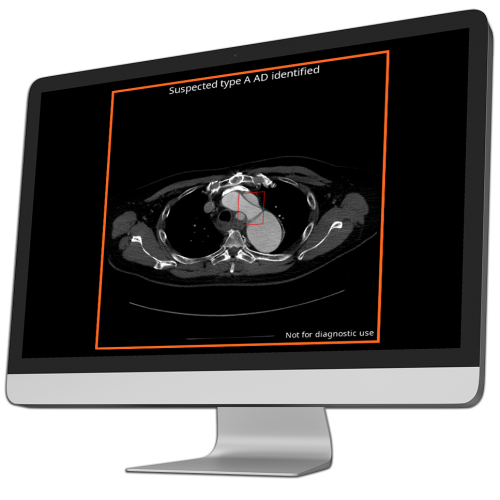
ct scan with suspected type a ad

Triage and notification tool for chest and thoraco-abdominal CT angiography in adults, flagging suspected Type A and Type B aortic dissection to support radiologist workflow prioritization.

Sensitivity
0 %
Specificity
0 %
AUC
0

Detection Coverage

Ascending aorta Descending aorta Aortic arch

Clinical Evidence

Peer-reviewed studies validating CINA-AD performance.

2024

Cotena et al.

Diagnostics

Aortic dissection demands immediate triage. In a multi-reader, multi-case study, researchers measured the direct effect of AI-assisted notification on the time from scan acquisition to a completed clinical assessment.

Reduction in scan-to-assessment
0 %

2024

Laletin et al.

Diagnostics

In a multicenter study of 1,303 CTAs across more than 200 cities and 52 scanner models, CINA-AD was evaluated on its ability to detect, classify, and notify, including in the most immediately life-threatening presentation.

Mean time-to-notification
0 sec

A Customer's Perspective

“Artificial Intelligence is here to help us. It is our companion. It can provide results, quantify, alert us about pathologies. By sorting images when we have 500 or 1,000 of them, we can focus on the most significant ones.”

smiling man in a blue jacket

Vincent Dousset

Head of Neuro-imaging, CHU Bordeaux (France)

Frequently Asked Questions

Aortic dissection is one of the most rapidly fatal cardiovascular emergencies. In Type A dissection, which involves the ascending aorta, mortality without surgical intervention rises by approximately 1 to 2% per hour in the first 48 hours. Type B dissection, limited to the descending aorta, carries lower immediate mortality but can progress to rupture, organ malperfusion, or hemodynamic instability without prompt medical management. In both cases, the time between scan acquisition and the first clinical decision directly affects patient outcome. CINA-AD delivers Stanford classification within seconds of acquisition, so the right team can begin preparation before the radiologist has opened the full case.

CINA-AD analyzes chest and thoraco-abdominal CT angiography to flag suspected aortic dissection, delivering a notification with Stanford classification (Type A or Type B) and four preview slices. In the standalone performance study (n=289), mean time-to-notification was 22.7 seconds. CINA-AD does not alter the original image and is not intended as a diagnostic device.

The Stanford classification divides aortic dissection into Type A (ascending aorta, emergency surgery required) and Type B (descending aorta, medical management first). The classification determines which clinical team needs to mobilize and how urgently. Knowing it at the moment of detection, before the full report, allows the appropriate team to begin preparation immediately.

CINA-AD, medical images analysis software, a medical device manufactured by Avicenna.AI. This medical device is reserved for health professionals. The performance and outputs of this tool may differ slightly according to the software version and applicable regulations.

This software has been designed and manufactured according to the EN ISO 13485 Quality management system. Read the instructions in the notice carefully before any use.

Instructions for Use are available.

Manufacturer: Avicenna.AI (France).

Medical device Class IIb following the European Regulation on Medical Device (EU) 2017/745.

Medical device Class II following the Code of Federal Regulations of the United States of America 21CFR on Medical Devices.

Download our Case study

Complete the form below to download our Case Study.

Related AI Solutions

Complete your AI portfolio.

CINA-iPE

Opportunistic PE detection

CINA-PE

Pulmonary Embolism Detection